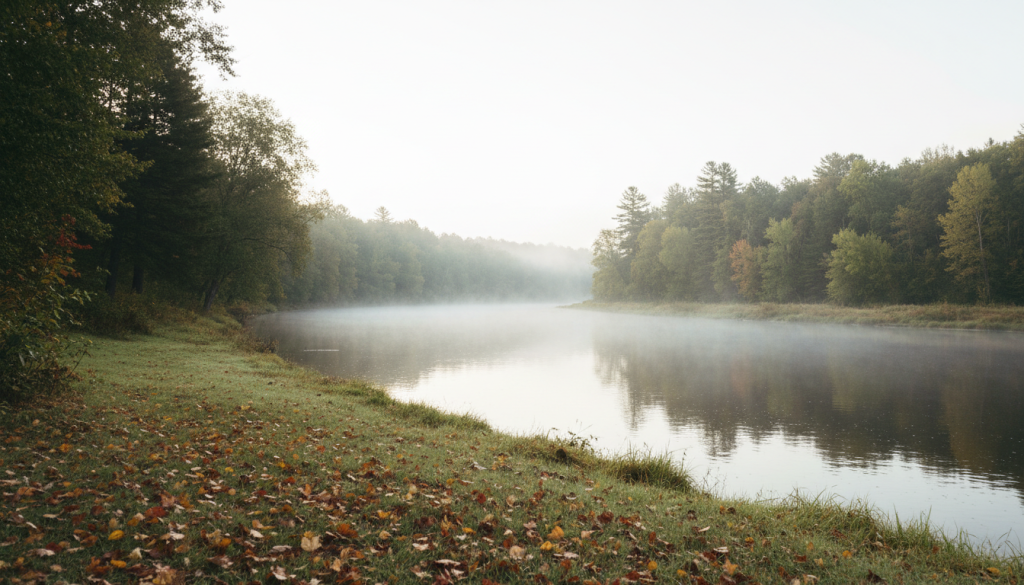
The fungus lives in moist soil and decaying wood and leaves, especially near rivers, lakes and wetlands. The old maps say it’s a Midwestern disease. The evidence says the map is too small.
The kind of ground it likes
- Moist, acidic, often sandy soil near fresh water
- Riverbanks, creek beds, lake shores and the soil near standing water
- Decaying wood and leaves: rotting logs, stumps, leaf litter
- The shores of beaver ponds, which breeders and vets describe as hotspots
Most dogs diagnosed with blastomycosis live within 400 meters (about a quarter mile) of a waterway.
The classic map
The CDC says the fungus is most common around the Ohio and Mississippi River valleys, the Great Lakes and the Saint Lawrence River, and in parts of Canada. But the CDC also says the exact range “is not known”: its maps are estimates, and the fungus may be present outside them.
The map is out of date
In 2022, researchers at Washington University in St. Louis (Mazi et al., Clinical Infectious Diseases) mapped Medicare diagnoses from 2007 to 2016. They found soil-fungus lung infections, including blastomycosis, being diagnosed in 48 of 50 states plus Washington, D.C., far beyond the regions doctors are taught to suspect.
New York: an emerging area
- 2017: Albany-area doctors alerted the New York State Department of Health to local cases, including several severe ones. The CDC reported that New York patients rose from an average of 24 a year (2007–2015) to 59 in 2016. One county along the Mohawk River averaged 2.2 cases per 100,000 people.
- 2026: A study in the CDC’s journal Emerging Infectious Diseases reviewed 54 confirmed cases at Albany Medical Center (2000–2024). Cases were stable until 2015, then rose sharply, with 13 in 2024 alone. 87% of patients were hospitalized, 57% had no underlying health condition, and none reported travel to known endemic areas. The authors concluded upstate New York “represents a new emerging endemic area” and suggested climate change may be a factor.
- New York City: A recent medical case report, “Blasto in the Bronx,” described a severe skin infection in a New York City patient.
New Jersey: nobody is counting
New Jersey isn’t on the classic map, but that doesn’t mean the fungus isn’t here. Only five states (Arkansas, Louisiana, Michigan, Minnesota and Wisconsin) require doctors to report blastomycosis, and New Jersey isn’t one of them. We found no public tracking of dog cases in New Jersey either. Without reporting, no one knows how many New Jersey dogs or people get it each year. At least one New Jersey human case appears in the medical literature (“An unusual case of North American blastomycosis in New Jersey”).
Around Flemington and Hunterdon County, the South Branch of the Raritan, the Delaware River, wooded floodplains, wetlands and beaver ponds offer the same kind of damp, leafy, waterside ground where the fungus is found elsewhere. That isn’t proof it’s here, but it’s a reason for vets and owners to keep it on the list.
Tell your vet where your dog has been
Include hikes, river swims, camping, hunting trips and any trip to the Midwest, Great Lakes, upstate New York or Canada in the past several months. Because the disease shows up weeks to months later, the exposure may be easy to forget.
Blasto Awareness shares public information for awareness only. It is not veterinary or medical advice. Sources: CDC; Merck Veterinary Manual; Purina Pro Club; MMWR 2018;67(38):1077–1078; Ramirez et al., Emerging Infectious Diseases 32(3), 2026; Mazi et al., Clinical Infectious Diseases, 2022; NYS Department of Health. Full list on the Sources page.